


Clearer Fracture X-rays with Medical Dry Imaging Film | JUDcare MDST-24
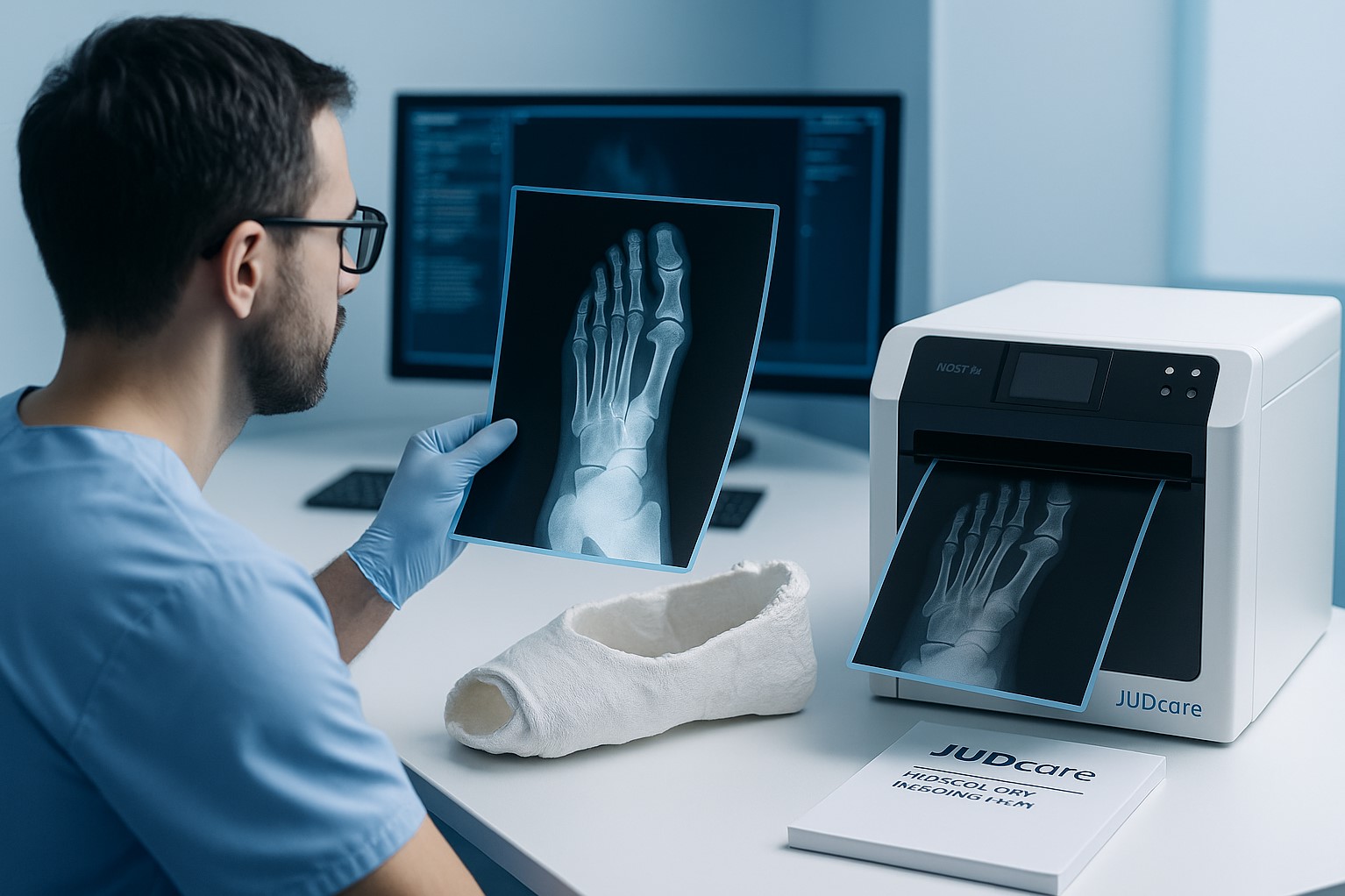
Plaster Casts & X-rays: How Medical Dry Imaging Film Enhances Fracture Diagnosis
A patient with a fracture at the base of the 5th metatarsal of the right foot received initial treatment via plaster cast immobilization. Approximately 25 days later, the patient returned for a follow-up examination. The physician ordered anteroposterior and oblique X-rays of the affected foot.The radio-logic technologist performed the scan without removing the cast and increased both kV and mAs in an attempt to enhance penetration and image quality. Despite these adjustments, the resulting image lacked clarity at the fracture site. Fracture lines and callus formation were poorly visualized, leading to uncertainty in the healing assessment.
Following a collaborative discussion between the radiologist, referring physician, and the patient, the cast was removed, and the X-ray was repeated. This second image showed substantially improved visualization, clearly revealing the healing process, callus formation, and proper bone alignment. The improved image allowed the care team to make more confident decisions regarding further treatment.
How Plaster Casts Interfere with Image Quality
Though plaster is technically translucent, several factors can compromise diagnostic clarity:
- Uneven cast thickness: Inconsistent X-ray attenuation reduces detail.
- Restricted positioning: Immobilization can prevent optimal imaging angles.
- Metallic components: Support bars or fasteners create distracting artifacts.
- Reduced contrast: Fine fracture lines and callus development may be obscured.
These limitations are especially critical during fracture follow-ups, where small differences in bone structure or alignment determine the next steps in treatment. Without a clear view, clinicians risk delayed diagnosis, repeat exams, or even inaccurate clinical decisions.
Best Practice: Collaborate Before Cast Removal
Whether or not to remove a plaster cast before imaging should be assessed case by case, based on:
- The visibility and location of the fracture
- Patient comfort and cast integrity
- Urgency for detailed assessment
- Consent and communication between care teams
Radiology departments should maintain clear communication with treating physicians and patients to choose the best path forward—balancing image quality with patient safety and comfort.
JUDcare’s Medical Dry Imaging Film Solution for Clear X-ray Output
For optimal results, obtaining high-resolution X-rays isn’t enough—the image output system must accurately preserve those details. That’s where JUDcare’s MDST-24 medical dry film printer and X-ray dry imaging film make a measurable difference.
MDST-24 Medical Dry Film Printer Highlights:
- High-definition thermal printing: Captures fine bone structures, fracture lines, and subtle healing changes.
- Fast throughput: Ideal for busy radiology departments and orthopedic clinics.
- Broad system compatibility: Works seamlessly with DR, CR, CT, and traditional X-ray modalities.
- Smart integration: Connects with PACS, HIS, and RIS platforms for automated output and reduced delays.
This printer minimizes wait times and enhances workflow reliability, which is crucial during high-volume clinical operations or trauma response.
Explore the Features of the JUDcare MDST-24 Medical Dry Film Printer
Advanced Medical Dry Imaging Film for Precision Diagnosis
Key Benefits of JUDcare Medical Dry Film:
-
High grayscale accuracy: Ensures subtle changes in bone structure or callus development are visible.
-
Excellent image clarity: Low fog levels enhance diagnostic value.
-
Thermal printer compatibility: Supports multiple dry printing systems across clinical setups.
-
Long-lasting images: Ideal for patient records, comparative studies, and follow-up assessments.
Learn more About JUDcare’s x-ray Dry Film Technology
Why Image Output Quality Matters More Than Convenience
This clinical reality underscores the importance of investing in high-performance printing solutions and imaging materials. The synergy between JUDcare’s MDST-24 and dry film supports precise, clear, and actionable results across departments.
Explore JUDcare digital transformation in healthcare through smart imaging technology
When image quality determines diagnosis, medical dry imaging film plays a vital role. Removing the plaster cast in certain cases can drastically improve the quality of follow-up X-rays and lead to more accurate treatment decisions. Equipped with JUDcare’s MDST-24 printer and high-contrast dry film, radiology teams are empowered to deliver clear, consistent results. This ensures each patient receives the highest level of diagnostic care—without compromise.
Q1: Does a plaster cast always need to be removed before an X-ray?
Not always. However, if image quality is compromised or fracture details are unclear, removal may be necessary for accurate diagnosis.
Q2: How does medical dry imaging film improve fracture assessment?
It provides high grayscale accuracy and low fog imaging, ensuring subtle bone changes—like callus formation—are clearly visible.
Q3: What makes the JUDcare MDST-24 printer ideal for follow-up X-rays?
Its high-definition thermal printing and system compatibility ensure reliable, detailed images suitable for fracture evaluation and treatment planning.
Q4: Can JUDcare film be used with other dry film printers?
Yes. JUDcare’s medical dry imaging film is compatible with most thermal dry film printers and supports consistent image quality.
Looking to modernize your hospital’s radiology workflow and improve imaging clarity?
Contact Us Today to explore how our medical dry imaging film and printing solutions can upgrade your radiology department.
The Evolution of Mobile Radiology | JUDcare Intelligent Imaging Workstations
Advanced Injector CT Scan Technology for Safe & Accurate Imaging | JUDcare Edot CP100
Related Article
