


Hospital Digital Transformation Challenges in HIS Modernization | JUDcare
2026-01-07
Why Hospital Digital Transformation Challenges Prevent Internet Giants from Reshaping Core Hospital Information Systems (HIS)
A Structural Analysis of Complexity, Governance, and Knowledge Barriers in Healthcare IT. In recent years, hospital digital transformation has accelerated rapidly, supported by the rise of cloud computing, AI, big data, and mobility. Major Internet companies have poured significant investment into the healthcare IT ecosystem, contributing to the development of smart hospitals and modern healthcare infrastructure.Yet despite these technological advances, the core Hospital Information System (HIS) the mission-critical transactional layer of hospital operations remains dominated by traditional HIS vendors. This is not a coincidence; it reflects the inherent barriers, workflow depth, and governance complexity that define healthcare IT worldwide.
Below is a structural breakdown that explains why even technologically powerful Internet enterprises struggle to reshape the HIS foundation during hospital digital transformation.
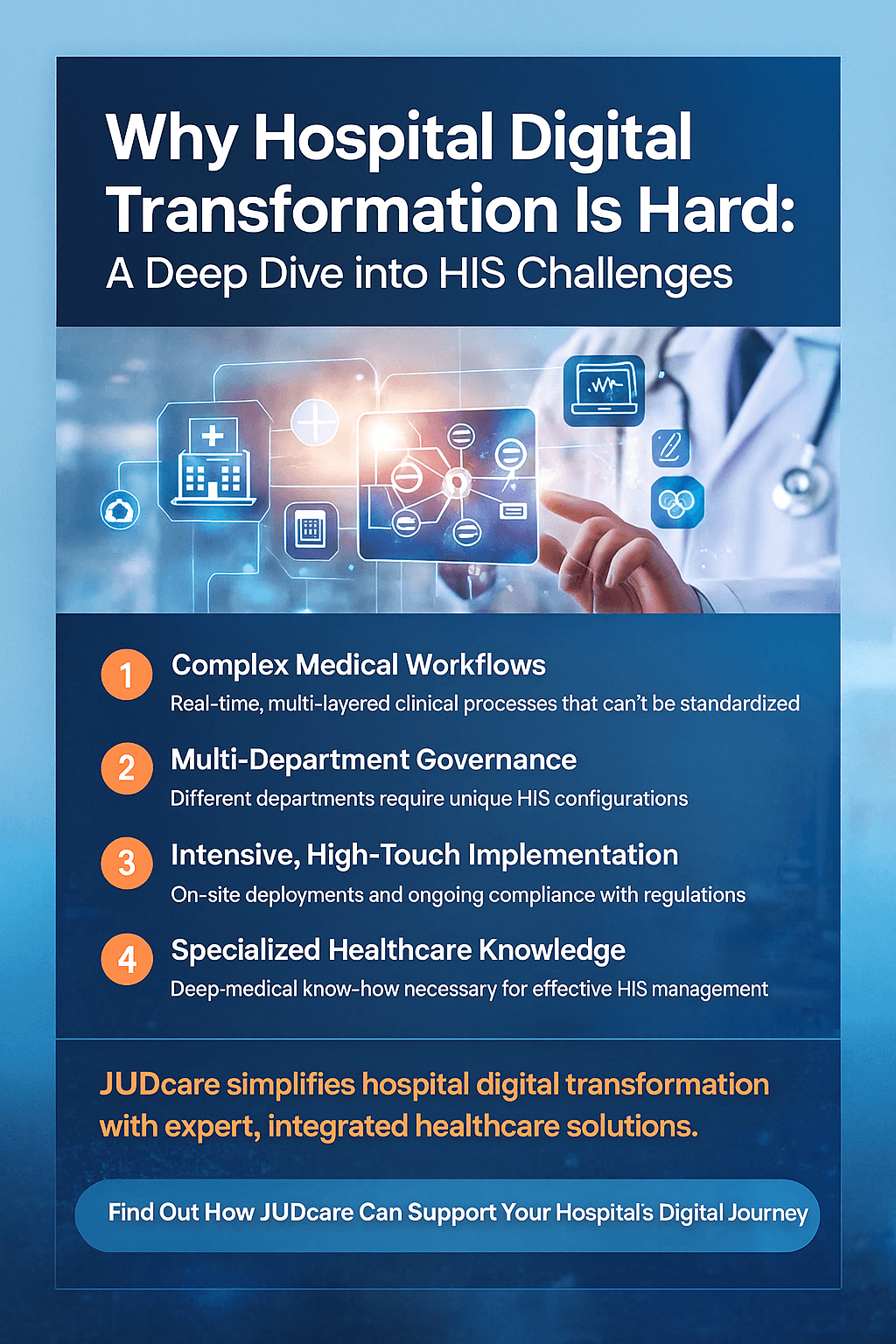
1. Medical Business Logic Is Intrinsically Complex and Resistant to Simplification
At the heart of every hospital digital transformation initiative lies deeply intertwined clinical and administrative workflows far more complex than the concurrency and scalability challenges typical of Internet platforms.
HIS must execute highly interdependent medical processes in real time, including:
-
Multistage clinical validation
-
Drug interaction checks
-
Medical insurance compliance
-
Laboratory, pharmacy, and nursing workflows
-
Public health and regulatory reporting
-
Reversible transactions and zero-error precision
For example, a single medication order triggers:
-
Insurance eligibility + DRG/DIP compliance
-
Drug–drug interaction alerts
-
Clinical pathway validation
-
Batch/expiration checks
-
Antimicrobial stewardship
-
Policy-mandatory reporting
Such complexity makes HIS a business-rules-driven system, not a traffic-driven one.
Learn how digital medical imaging supports hospital digital transformation in our article: JUDcare Leads Smart Healthcare Standardization The New Era of Medical Imaging Technology.
Learn how digital medical imaging supports hospital digital transformation in our article: JUDcare Leads Smart Healthcare Standardization The New Era of Medical Imaging Technology.
2. Multi-Center Governance Makes HIS Hard to Standardize
Hospitals are among the most structurally complex institutions in any industry. Every department radiology, pharmacy, surgery, outpatient, inpatient, emergency operates under its own workflow logic, terminology, and historical practices. This makes HIS the digital twin of hospital governance, not just a software product.
Globally, the same pattern holds:
-
U.S.: Epic, Cerner require long, deeply customized implementations.
-
Japan: HOPE HIS adapts to complex decentralized clinical processes.
-
Europe: IHE-based systems require configuration-heavy deployments.
This complexity severely limits the “standard product + rapid deployment” model of Internet companies during hospital digital transformation
Explore how JUDcare’s Self-Service Kiosk Solutions streamline hospital workflows and support HIS modernization.
Explore how JUDcare’s Self-Service Kiosk Solutions streamline hospital workflows and support HIS modernization.
3. Healthcare Informatization Requires Heavy, On-Site Implementation
Unlike Internet services built for replication and scalability, HIS requires:
-
On-site deployment
-
Deep workflow redesign
-
Long-term operational support
-
Continuous regulatory adaptation
-
Complex stakeholder coordination
-
Extended payment cycles
Even leading HIS vendors worldwide depend on large on-site teams. In other words, HIS is not a SaaS-like product it is an engineering project with long-term maintenance, making it incompatible with the rapid-scale strategies typical of Internet giants.
See how cloud film and smart imaging platforms reduce HIS operational burden in JUDcare’s AI Medical Imaging Solutions at CCR2018.
See how cloud film and smart imaging platforms reduce HIS operational burden in JUDcare’s AI Medical Imaging Solutions at CCR2018.
4. Knowledge Barriers Are Exceptionally High and Not Easily Transferable
HIS teams must deeply understand evolving healthcare rules, including:
-
DRG/DIP payment reform
-
Clinical pathways
-
Rational drug-use policies
-
HL7 v2/v3, FHIR, and IHE standards
-
Pharmaceutical traceability
-
Hospital performance evaluation rules
This expertise is mostly tacit knowledge, gained through years of:
-
Policy interpretation
-
On-site implementation
-
Iterative workflow adjustments
Global evidence reinforces this:
-
U.S. hospitals rarely switch HIS due to massive data + workflow complexity.
-
Japan keeps systems stable for decades.
-
Europe requires multi-year transition programs for HIS modernization.
Such knowledge cannot be replicated quickly, even by Internet giants with strong technical backgrounds.
5. Hospital Digital Transformation Requires Long-Term Co-Evolution
Internet companies have accelerated innovation in cloud computing, mobility, and AI within healthcare. But transforming HIS the core engine of hospital operations requires more than technical strength.
Successful hospital digital transformation depends on:
-
Deep, long-term understanding of clinical workflows
-
Continuous alignment with medical governance and policy changes
-
High-touch implementation and delivery capacity
-
Co-evolution between hospitals, vendors, and regulators
Modernizing HIS is not a rapid technological upgrade. It is a long-term transformation requiring deep partnership, domain expertise, and operational endurance.
Conclusion: The road to successful hospital digital transformation is complex. Challenges from workflow alignment and legacy systems to governance, knowledge gaps, and regulatory requirements remain significant. Hospitals must adopt a long-term digital strategy, invest in scalable HIS architecture, and prioritize interoperability to achieve true transformation. Modern medical imaging solutions play a critical role in this process. By adopting intelligent, connected, and patient-centered systems, hospitals can accelerate their digital transformation journey and improve operational efficiency.
Ready to support your hospital digital transformation?
Explore JUDcare’s intelligent medical imaging solutions built for efficiency, connectivity, and long-term digital innovation.
Explore JUDcare’s intelligent medical imaging solutions built for efficiency, connectivity, and long-term digital innovation.
Digital Radiography in Hospitals | DR vs CR Comparison Guide
JUDcare Leads Smart Healthcare Standardization | The New Era of Medical Imaging Technology.
Related Article

Discover how AI radiology is transforming modern healthcare through faster diagnosis, smarter workflows, cloud PACS integration, and improved patient outcomes. Learn how JUDcare supports AI-powered medical imaging.
AI Radiology: How Artificial Intelligence Is Transforming Modern Medical Imaging | JUDcare
Learn how to choose the best CT contrast injector for modern hospitals. Discover key features, patient safety considerations, workflow benefits, and innovative solutions from JUDcare.
How to Choose the Best CT Contrast Injector for Modern Hospitals | JUDcare